


This site is protected by reCAPTCHA and the Google Privacy Policy and Terms of Service apply.
Day-1 CPT offers a rapid, cost-effective, and lawful solution for international students facing legal status dilemmas while planning to stay in the United States. This article serves as a comprehensive resource addressing two primary areas: the 5 most common fundamental questions about Day-1 CPT and the 5 crucial considerations for students contemplating its usage.
If you're grappling with legal status dilemmas in the United States and wondering how Day-1 CPT can help you stay, or if your situation is suitable for Day-1 CPT, this article is your ultimate guide. I'll provide you with detailed insights and guidance for self-assessment. If you've already decided to opt for Day-1 CPT, we'll walk you through the entire school selection process and key considerations. Additionally, I'll compile the latest and most comprehensive list of the schools that you should definitely avoid and introduce you to high-quality institutions to assist you effectively!
Background Info
Here is some information about CPT and OPT to help you have a better understanding of Day-1 CPT. If you are already familiar with them, feel free to skip directly to the main content below.
The Fundamental Rule for CPT, OPT, and Day-1 CPT:
For students who plan to use these work authorizations, all employment must be at least partially related to their field of study.
What is CPT?
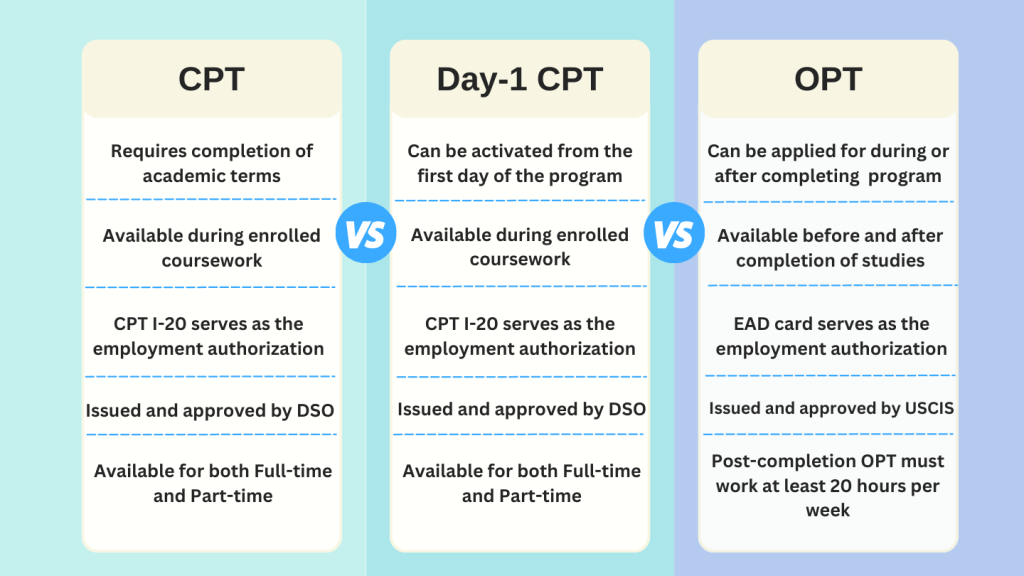
Curricular Practical Training (CPT) is a work authorization for F-1 visa students during their program of study. CPT allows international students to gain practical working experience related to their major through either an employment or an internship.
Two types of CPT
Full-time CPT:
Requires students to work over 20 hrs per week. Technically, there is no upper limit, except some universities may have the requirement that full-time CPT can’t work over 40 hrs per week to prevent students from negatively affecting their studies.
Part-time CPT:
Requires students to work below 20 hrs per week.
What is OPT?
Optional Practical Training (OPT) is a 12-month work authorization for F-1 students after graduate. For students who graduated from STEM program, they can apply for a 24-month STEM OPT extension after the first year OPT.
What is Day-1 CPT?
Day-1 CPT is Curricular Practical Training (CPT) that can be activated as early as the first day of the program.
In most programs in the US, students are required to wait a certain period, typically one or two semesters, before they are eligible to apply for Curricular Practical Training (CPT).
However, some programs offer Day-1 CPT, allowing students to apply for and engage in practical training from the first day of their program. And we call these kind of programs ‘Day-1 CPT Program’.
5 Common Asked
What is Day-1 CPT?
In the United States, it’s quite common for university master’s programs to value hands-on work experience. They believe it significantly enriches students' learning journey. That’s why these programs often offer students the opportunity to engage in Curricular Practical Training (CPT) right from the start of their enrollment.
Day-1 CPT Definition:
Students are permitted to start work legally through CPT as early as the first day of the semester, or even earlier, based on the rules/regulations of the institution, while they pursue their studies.
The U.S. Citizenship and Immigration Services (USCIS) pays close attention to how Day-1 CPT is used. A key factor is whether the school is accredited, and it needs to show USCIS that the students’ internship is really tied to what they’re studying. If schools don’t stick to these regulations, there could be tough consequences, leading to negative outcomes for their students.
If you're considering Day-1 CPT, it’s important to ensure that the internship job responsibilities align, at least in part, with your academic program. Before starting to use CPT to work, students are required to submit the relevant company information to their school’s International Student Office (ISO) for approval. Approval from the school is a prerequisite for beginning any legal internship under CPT. Additionally, throughout their academic engagement, students must maintain full-time student status(full-time F-1 status), attending classes and completing assignments on time. Failure to meet these academic requirements may result in disciplinary actions, such as warnings or potential expulsion from the institution.
Is Day-1 CPT Legal?
Absolutely! Day-1 CPT is legal! Day-1 CPT is fully compliant with U.S. laws and regulations as long as certain prerequisites are met. This is supported by guidelines from the Department of Homeland Security, U.S. Immigration and Customs Enforcement, and the Code of Federal Regulations.
Day-1 CPT is entirely in compliance with U.S. laws and regulations as long as certain prerequisites are met.
Requirements for using Day-1 CPT:
- Maintain Full-Time F-1 Student Status: To be eligible for Day-1 CPT, you must maintain your F-1 student status by fulfilling both the attendance and full-time enrollment requirements set by your school. For most graduate programs, this means completing 6 to 9 credit hours per semester, as specified by university policies and the Designated School Official (DSO). It's crucial to keep up with these requirements each semester to remain a full-time student. Failure to do so may result in the loss of your CPT authorization, making it illegal for you to continue working. Moreover, your school may impose additional penalties, such as warnings or even expulsion, if you do not comply with these standards.
- Job Relevance to Your Academic Program: The work you engage in under Day-1 CPT must be partially related to your field of study. For example, if you are majoring in Computer Science, your job should involve applying some of the skills or knowledge you've gained from your program. Similarly, if you're studying Data Analytics, your work might involve using technical skills acquired from your coursework for tasks like data analysis.
- Application and Approval Process: You can apply for CPT work authorization immediately after enrollment. However, remember that you can only begin working legally in the U.S. during the valid CPT period after your application has been reviewed and accepted by your school. Approval is not automatic upon enrollment; you'll need to submit the necessary documents to your school's International Student Office(DSO) and wait for their approval. Once approved, you can begin working as early as the first day of classes (or possibly earlier, depending on your school's specific requirements).
Official Information Source:
> Eligibility
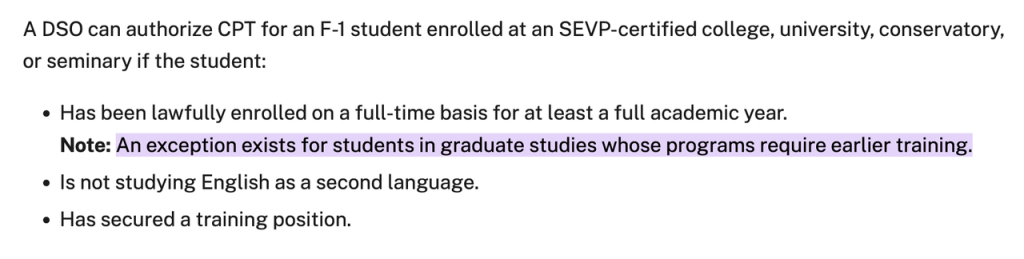
Department of Homeland Security - F-1 CURRICULAR PRACTICAL TRAINING (CPT)
> CPT
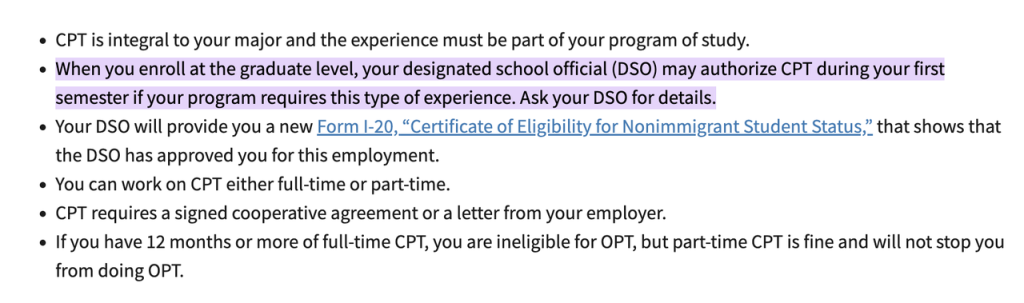
U.S. Immigration and Customs Enforcement - Practical Training
> CPT - Guidelines and Authorization Process
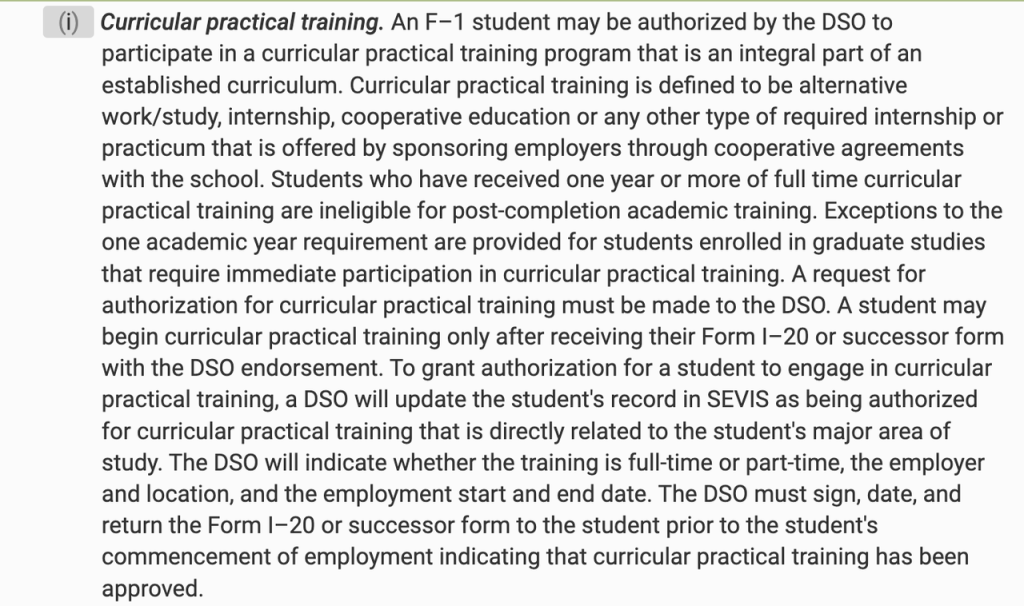
Code of Federal Regulations - Practical Training
Day-1 CPT Risks
Risk 1: Does Day-1 CPT increase the risk of receiving an RFE of H-1B?
In the United States, applicants for H-1B visas may encounter situations where they receive a Request for Evidence (RFE). Previous use of Day-1 CPT may potentially impact the H-1B application process. The H-1B visa is a non-immigrant visa designed for foreign professionals working in specific fields.
While the use of Day-1 CPT itself doesn't directly raise the risk of an H-1B RFE, immigration authorities may scrutinize the details of previous CPT usage more thoroughly during the H-1B application process.
Here are factors that could lead to an RFE:
- Irrelevant job duties: If your work during Day-1 CPT is not related to your field of study, it might be considered an abuse of CPT regulations, increasing the likelihood of an H-1B application being questioned.
- School credibility issues: If a school is under scrutiny for violating regulations, students associated with that school may be affected. Immigration officers may question the credibility of the institution, potentially impacting your H-1B approval.
- Failure to fulfill F-1 student responsibilities:This includes situations where a student repeats the same degree or pursues an unreasonable academic path. In such cases, the use of Day-1 CPT might be seen as an academic strategy rather than a genuine internship or work experience, drawing attention from immigration officers.
- Violation of CPT regulations: Working outside the authorized period, exceeding the weekly work hours, or other non-compliance issues can significantly impact your H-1B application process, leading to an RFE.
Risk 2: Choosing Unaccredited Day-1 CPT Schools
As the demand for Day-1 CPT increases, immigration authorities are more vigilant in examining universities that offer Day-1 CPT programs. Choosing a school that lacks proper accreditation may affect your current legal status and future plans in the U.S. Common types of non-compliant Day-1 CPT institutions include:
- For-profit Diploma Mills: These universities have a short history, minimal facilities, and may lack qualified faculty. They might charge low tuition fees and fail to monitor attendance properly. Several institutions of this type have faced serious penalties in recent years.
- Homeland Security (DHS) Official Bait-and-Switch Universities: These schools may provide extensive documentation to appear legitimate and promote their programs aggressively. However, if you fail to meet full-time student requirements, your status could be terminated immediately, leading to potential deportation. This situation is a disguised way of reminding F-1 students to adhere to their responsibilities.
Risk 3: Failing to Maintain F-1 Student Status During Pursuing Day-1 CPT Program
It's crucial to prioritize maintaining your F-1 student status while participating in Day-1 CPT programs.
F-1 student status requires your to fulfill several responsibilities related to your studies, such as completing assignments on time, attending all in-person classes, avoiding exam absenteeism, and maintaining a GPA above the school's minimum standard (typically 3.0 or higher). Failure to meet these responsibilities may lead immigration authorities to suspect that you are using your studies as a way to maintain status rather than for genuine educational purposes, which may result in serious consequences.
7 Day-1 CPT Schools You Should Avoid

Silicon Valley University
- Operational Status: No
- Accreditation: None
- School Penalty: Closed, Suspension
- Impact on Students: F-1 status revoked
University of Farmington
- Operational Status: No
- Accreditation: None
- School Penalty: Suspension, corrective action
- Impact on Students: Arrest/Deportation
International Technological University
- Operational Status: Yes
- Accreditation: Yes
- School Penalty: Compensation
- Impact on Students: Higher likelihood of RFE
Stratford University
- Operational Status: No
- Accreditation: None
- School Penalty: Closed, suspended
- Impact on Students: F-1 status jeopardized
Fairfax University of America
- Operational Status: Yes
- Accreditation: Yes
- School Penalty: Suspension, corrective action
- Impact on Students: Higher likelihood of RFE
Who Should Consider Day-1 CPT?
If Your Employer Doesn't Sponsor H-1B
If your current employer can’t sponsor an H-1B visa due to company size or qualifications, you might consider enrolling in a Day-1 CPT program. This allows you to continue working with your employer under CPT status while also enhancing your qualifications and gaining valuable experience.
If You Weren't Selected by the H-1B Lottery
If you are dealing with the limitations of your OPT duration and the uncertainty of the annual H-1B lottery, Day-1 CPT can be a great alternative. It provides you with the opportunity to continue working legally in the U.S. while participating in multiple H-1B lotteries, increasing your chances of securing an H-1B visa.
If Your OPT Is Expiring
If your OPT is nearing its expiration and you haven’t secured a satisfactory job, pursuing a higher degree through a Day-1 CPT program might be ideal. This gives you extra time to search for a job and allows you to start working immediately once you find one, without the need to wait until graduation.
If You Need an Urgent Transfer
If you find yourself in a situation where you face academic integrity violations or other issues leading to suspension or expulsion from your current school, you need to address your legal status quickly. A Day-1 CPT program offers a fast admission process, helping you maintain your F-1 student status and stay legally in the U.S. while completing your studies.
If You're in a Status Transition Period (H1B to F; B1/2 to F; L1/2 to F)
If you’re transitioning between visa statuses (like moving from H-1B, L-2, or H-4 with work permits) and face challenges such as unsuccessful extensions or insufficient time to find a new job, enrolling in a Day-1 CPT program can be a practical solution. This helps you maintain legal status in the U.S. while continuing your studies with the flexibility offered by Day-1 CPT programs.
5 Considerations - How to Choose a Day-1 CPT University?
Check School Accreditation
Make sure the school is accredited by recognized U.S. educational accrediting agencies, whether regional or national. Accreditation is crucial because it guarantees the quality of education you'll receive. Be wary of schools without proper accreditation, as attending an unaccredited institution could impact your status and future plans. Always opt for schools with valid, current accreditation, and avoid those that have lost it.
Common Accrediting Agencies:
Middle States Commission on Higher Education
(MSCHE)
Accredited schools:
- Harrisburg University
- Monroe University
- McDaniel College
WASC Senior College and University Commission
(WSCUC)
Accredited schools:
- Westcliff University
- Sofia University
- Humphreys University
New England Commission of Higher Education
(NECHE)
Accredited schools:
- New England College
The Higher Learning Commission
(HLC)
Accredited schools:
- Trine University
- Ottawa University
- National Louis University
- Avila University Arizona
- Benedictine University
- Indiana Wesleyan University
Southern Association of Colleges and Schools Commission on Colleges
(SACSCOC)
Accredited schools:
- Texas Wesleyan University
Research the School's History
Examining the establishment history of a school is crucial for informed decision-making.
Generally, a school with a long and early history may offer more assurance compared to those established more recently.
In addition to official platforms verifying the school's accreditation and qualifications, it's beneficial to explore alumni feedback on social media and forums. When delving into a school's history, consider researching whether it has been associated with any negative news, as such incidents can impact the school's reliability.
Look into the school’s history to check for any recent negative news or records of violations. Even some well-known Day-1 CPT schools have faced issues like revocation of accreditation or legal penalties but continue to operate. Being aware of a school's history will help you make an informed decision and avoid potential risks.For information on negative news related to specific prominent Day-1 CPT schools, refer to our earlier sections:
Seven Day-1 CPT Schools You Should AvoidSuitable Program
Choosing the right Day-1 CPT program is the foundation of selecting a school, and there are two fundamental principles should guide this decision:
> Relevance to Current and Future Career:
Selecting a Day-1 CPT program should align with your current job and future career plans. The fundamental principle for applying CPT for work is that the job responsibilities should have some relevance to the current academic program. While the program doesn't need to precisely match your current job, it should incorporate aspects that utilize your current academic knowledge.
> Logical Progression in Educational Path:
Ensure that your educational path makes sense when choosing a Day-1 CPT program. If you already hold a bachelor's degree, consider pursuing a master's degree, followed by a potential Ph.D. Alternatively, if you already have a master's degree, you may choose a different master's program or opt for a Ph.D. The following breakdown provides detailed insights:
Choosing the First Master's Degree:
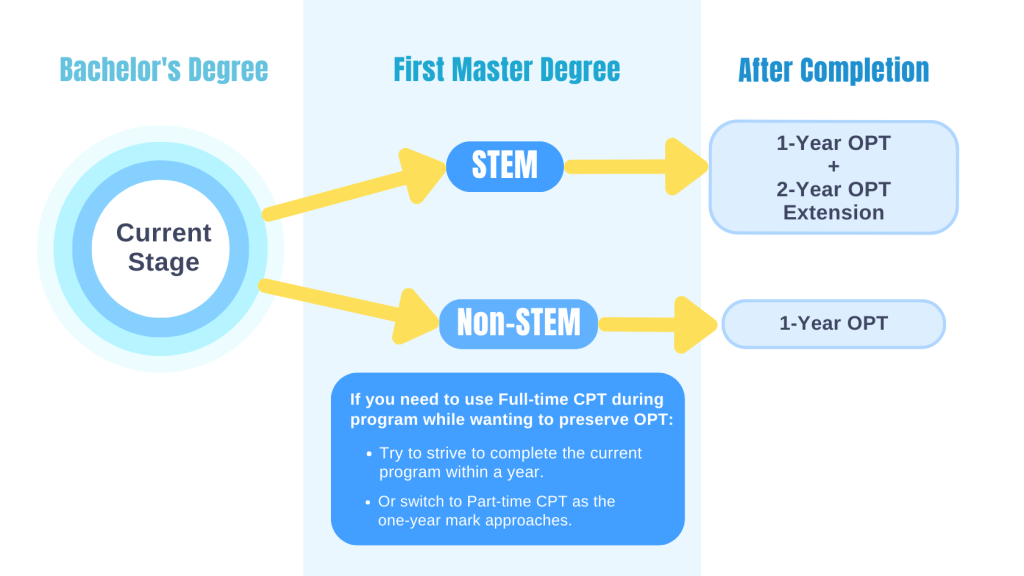
Opt for a Day-1 CPT master's program that offers flexibility and aligns with your career interests.
For those with full-time work requirements during the Day-1 CPT program, select a one-year program to preserve the opportunity to apply for Optional Practical Training (OPT) during the graduate stage.
Consider STEM-certified master's programs, as they provide the chance for a 24-month OPT extension after the initial one-year OPT.
If participating in the H-1B lottery is part of your future plans, consider selecting a nonprofit school to improve your chances of qualifying for the H-1B Master Cap lottery. You can verify a school’s nonprofit status through resources like the College Navigator.
- Day-1 CPT Universities Offering STEM Master's Programs
- > Westcliff University
- Master of Business Administration
- MS in Engineering Management
- MS in Computer Science
- MS in Information Technology
- Doctor of Business Administration
- > Sofia University
- MS in Computer Science
- > Humphreys University
- Master of Business Administration – IT
- > Trine University
- M.S. Engineering Management
- M.S. Information Studies
- M.S. Business Analytics
- Doctor of Information Technology
- > Ottawa University
- Executive Master in Business Administration
- Masters of Science in Computer Science
- > Monroe University
- MS in Computer Science
- Master of Science in Data Science
- Business Management, Analytics, and Information Technology, MBA
- > Harrisburg University
- ISEM, LTMS, CISC, MSA, MSPM, HCIN, MSB, CBDS, CYOM, HCID, MSPS, ENTP
- All 12 programs supporting Day-1 CPT at Harrisburg University are STEM disciplines.
- > Harrisburg University
- M.S. in Business Analytics
- M.S. in Data Science
- > McDaniel College
- Master of Science in Data Analytics
- > New England College
- Executive Information Technology & Project Management, MS
- Executive Master of Business Administration, Software Engineering
- Executive Data Science & Analytics, MS
- Executive Information Technology (IT) & Cybersecurity, MS
- Executive Artificial Intelligence, MS
- > National Louis University
- M.S. in Business Data Analytics
Choosing the Second Master's Degree:
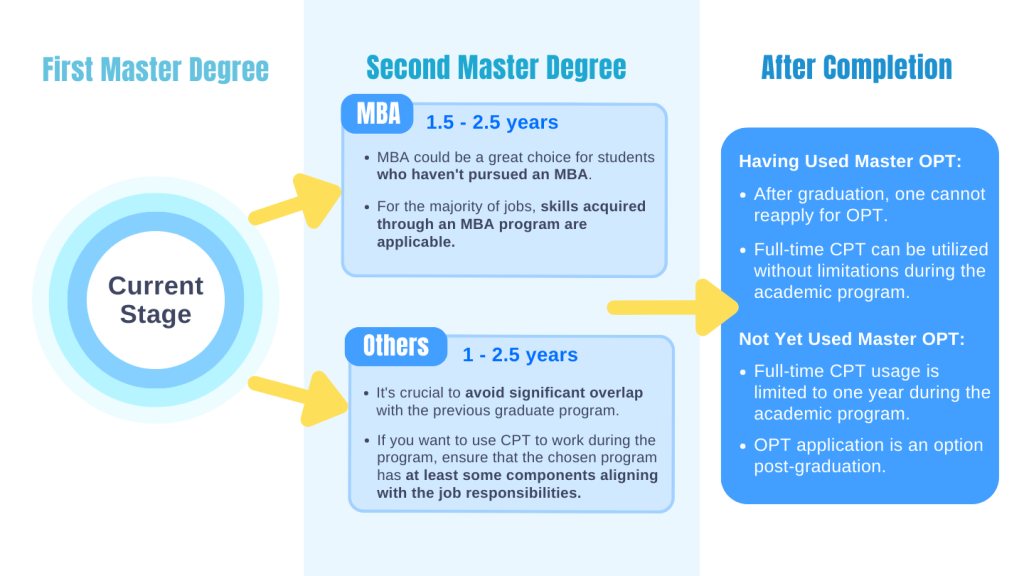
If you are considering a second master's degree using Day-1 CPT, think about choosing a program that differs from your first master's degree. Although there is no specific evidence that having two degrees in the same field increases the risk of an RFE for H-1B or green card applications, diversifying your educational background can be advantageous.
If the initial master's degree school isn't eligible for the H-1B Master Cap lottery due to nonprofit status, opt for a nonprofit-eligible school for the Day-1 CPT program to qualify for the lottery after graduation.
For students contemplating their second master's degree, especially if they haven't pursued an MBA before, giving priority to an MBA (Master of Business Administration) program is advisable. Regardless of the current industry, the demand for skilled managers is universal. By communicating with employers and supervisors to make minor adjustments to the job description and aligning daily tasks with MBA course requirements, applying for CPT becomes a streamlined process. Embracing an MBA can offer versatility and convenience in navigating your academic and professional journey.
- Day-1 CPT Universities Offering MBA Program
- > Westcliff University
- Master of Business Administration
- > Sofia University
- Master of Business Administration
- > Humphreys University
- Master of Business Administration – IT
- > Trine University
- M.S. Business Analytics
- > Monroe University
- Master of Business Administration
- > Ottawa University
- Executive Master in Business Administration
- > New England College
- Executive Master of Business Administration
Considering a Doctoral Program:
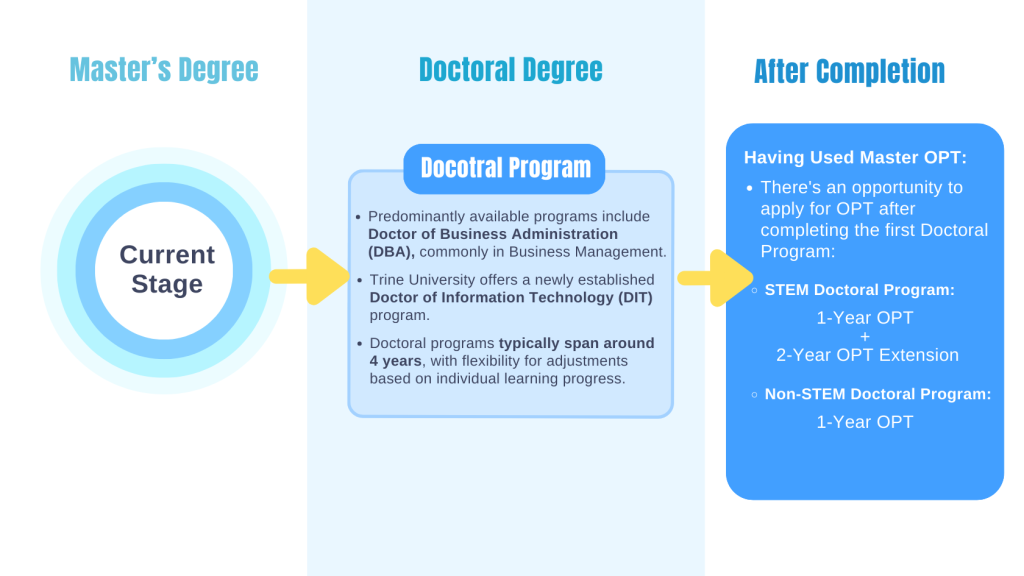
For those who have successfully completed their graduate studies, the next step may involve considering a doctoral program. Upon completing a doctoral program, there's an opportunity to apply for Optional Practical Training (OPT) during the doctoral stage. This strategic decision rationalizes your current academic journey and minimizes the risk of Request for Evidence (RFE) in subsequent processes.
- Day-1 CPT Universities Offering Doctoral Program
- > Westcliff University
- Doctor of Business Administration
- > National Louis University
- Doctor of Business Administration
- > Ottawa University
- Doctor of Business Administration
- > Trine University
- Doctor of Information Technology
- > Sofia University
- Doctor of Business Administration
- > Harrisburg University
- PhD in Data Sciences
- PhD in Computational Science and Engineering
- PhD in Information Systems Engineering and Management
Check out full list of Day-1 CPT doctoral programs here: https://day1cptapply.com/day-1-cpt-doctoral-programs/
Location
An easily accessible campus is way more important than most students think!
Based on USCIS's requirement for full-time F-1 visa holders, you are typically allowed to take only one online course per semester, so it's crucial to find a school that offers a balanced mix of online and on-site classes. Select a school close to your workplace or residence to minimize commuting time and costs, allowing you to focus more on your studies and work.
Luckily most Day-1 CPT schools will only require to attend on-site classes several times each semester (for example, Trine University's onsite frequency is once a semester, Harrisburg University's onsite frequency is once every two months).
Tuition
For balancing work and studies, if the tuition is affordable, it is also a point to think about. While filtering for budget-friendly options, it’s essential to be cautious of excessively low tuition fees, which can be a red flag for potential issues. Your decision should be based on a comprehensive evaluation, taking into account all the tips for choosing Day-1 CPT schools we mentioned earlier. Selecting a school only based on low tuition costs, without considering other factors, may lead to complications in your current status and future H-1B visa processing.
> Top 3 Affordable Day-1 CPT Schools in the U.S. West Coast
| Day-1 CPT Program | Total Program Tuition | Program Credits | Per Credit Tuition | |
|---|---|---|---|---|
| Trine University | Master of Business Administration | $17,250 | 30 | $575 |
| M.S. Business Analytics | $17,250 | 30 | $575 | |
| M.S. Information Studies | $17,250 | 30 | $575 | |
| M.S. Engineering Management | $17,250 | 30 | $575 | |
| Doctor of Information Technology | $42,000 | 60 | $700 | |
| Sofia University | Master of Business Administration | $24,696 | 36 | $686 |
| Master of Science in Computer Science | $25,704 | 42 | $612 |
> Top 3 Affordable Day-1 CPT Schools in the U.S. East Coast
| Day-1 CPT Program | Total Program Tuition | Program Credits | Per Credit Tuition | |
|---|---|---|---|---|
| New England College | Executive Information Technology & Project Management, MS | $17,952 | 36 | $440 |
| Executive Master of Business Administration | $17,952 | 36 | $440 | |
| Executive Data Science & Analytics, MS | $19,800 | 40 | $440 | |
| Executive Information Technology (IT) & Cybersecurity , MS | $19,800 | 40 | $440 | |
| Harrisburg University | M.S. in Data Science | $35,100 | 36 | $975 |
| M.S. in Business Analytics | $29,250 | 30 | $975 | |
| Monroe University | Master of Business Administration | First U.S. Master’s Degree: $33,084 Second Master’s Degree: $19,440 |
36 | $667 |
| Master of Science in Computer Science | First U.S. Master’s Degree: $33,084 Second Master’s Degree: $19,440 |
36 | First U.S. master’s degree: $919 Second Master’s Degree: $540 |
|
| Master of Science in Data Science | First U.S. Master’s Degree: $33,084 Second Master’s Degree: $19,440 |
36 | First U.S. master’s degree: $919 Second Master’s Degree: $540 |
|
| Data Science Certificate | $4,310 | 18 | $610 |
Need Help Choosing the Right Day-1 CPT University? If you have any further questions or need personalized guidance on selecting a Day-1 CPT program, feel free to contact us! We offer free consultations and support to help you make the best decision for your academic and career path.
Still have questions?
We are here to help!
Free Consultation Facebook Group