


This site is protected by reCAPTCHA and the Google Privacy Policy and Terms of Service apply.
Day-1 CPT is a popular option for F-1 students who want to keep working in the U.S. while staying in status. But it also comes with real risks and if you don’t understand them fully, you could run into serious immigration trouble down the road.
This guide walks you through the four most common risk areas students face when using Day-1 CPT: how it may affect your H-1B, your visa status, your school choice, and how immigration officers might view it. We’ll also show you what you can do to avoid mistakes and use Day-1 CPT the right way.
Quick Introduction of Day-1 CPT
Day-1 CPT allows F-1 visa students to begin working or interning from the first day of the program. Unlike traditional CPT, which usually requires students to complete one or two semesters before applying, CPT is available from the start in Day-1 CPT programs designed to incorporate immediate practical training.
Here is the comparison table between CPT, Day-1 CPT, and OPT to help you have a better understanding of Day-1 CPT.
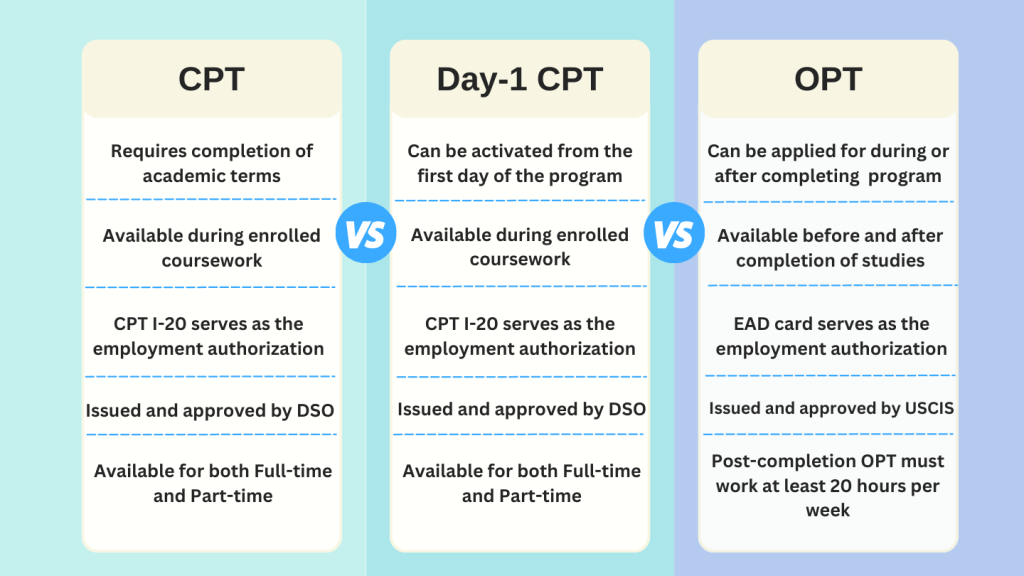
For more detailed information on how to choose a Day-1 CPT university, check out our comprehensive guide: Day-1 CPT Comprehensive Guide.
4 Common Day-1 CPT Risks Students Ask About
Risk 1: Could Using Day-1 CPT Increase My Chances of Getting an H-1B RFE?
Short answer: Yes, if your CPT history doesn’t look legitimate to USCIS.
When applying for an H-1B, some students receive a Request for Evidence (RFE) asking them to prove they maintained valid status while on CPT. Here are some of the most common red flags:
- Your CPT job wasn’t related to your major
- You worked before CPT was authorized
- Your school is under investigation or has poor credibility
- You repeated the same degree (e.g. two MSCS programs)
USCIS isn’t just checking forms; they’re looking at the full pattern of your study and work history.
💡 What to do: Only work in jobs tied to your degree, don’t start before CPT is approved, and choose Day-1 CPT universities with solid reputations.
👉 Not sure which Day-1 CPT school fits your background? Use our career-based Day-1 CPT university guide to find options that align with your long-term goals: Career-based Day-1 CPT Schools Guide.
Risk 2: Can Choosing the Wrong Day-1 CPT University Put My Status at Risk?
Short answer: Absolutely.
Some schools offering Day-1 CPT are not academically credible and USCIS knows it. Enrolling in one of these schools can impact your current F-1 status and your future immigration plans.
Types of problematic Day-1 CPT universities:
- For-profit diploma mills: Very low tuition, few in-person classes, no clear academic structure.
- DHS-monitored bait schools: These schools may look legitimate on paper, but are monitored by the U.S. government to detect status abuse. If you violate even one rule, your SEVIS could be terminated immediately.
💡 And in some cases, the entire “school” may be part of a government sting operation.
For more information on identifying “diploma mills” offering non-compliant Day-1 CPT programs, please check this blog: Seven Day-1 CPT Schools You Should Avoid.
Real Case: The University of Farmington Sting Operation
In 2019, U.S. Immigration and Customs Enforcement (ICE) created a fake school called the University of Farmington. It had a real-looking website, offered Day-1 CPT, and even issued I-20s. But it had no classes, no professors, and no real degree program.
More than 600 international students enrolled, most didn’t know it was fake. Over 100 were placed in deportation proceedings. Eight recruiters were arrested.
👉 Even if your school gives you an I-20, you are responsible for making sure your education is legitimate.
In its official statement, ICE emphasized that F-1 students must “make normal progress toward completing a course of study.” Enrolling in a program that doesn’t meet that standard, even unknowingly, can lead to serious consequences.
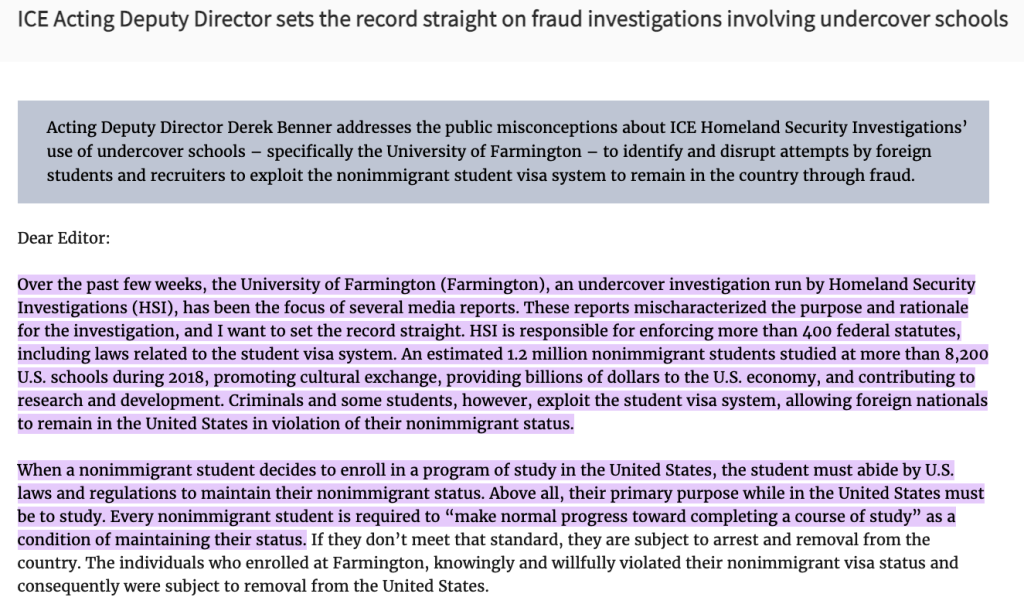
U.S. Immigration and Customs Enforcement — ICE Acting Deputy Director sets the record straight on fraud investigations involving undercover schools
✨ Pro tip: If your Day-1 CPT plan makes sense and your Day-1 CPT program is real, you’re on the right track. But if something feels “too easy,” like no classes or no requirements, it’s worth double-checking.
If you have any questions about selecting a Day-1 CPT university, feel free to contact us for a FREE consultation.
Risk 3: Will I Lose My F-1 Status While on Day-1 CPT?
Short answer: Yes, if you don’t meet your academic requirements.
Participating in Day-1 CPT doesn’t make you exempt from your F-1 responsibilities. You’re still expected to:
- Attend required in-person classes
- Submit assignments and exams
- Maintain a GPA above your school’s minimum (typically 3.0 or higher)
If you fall behind in your coursework or violate your school’s policies, your SEVIS record could be terminated—even if your CPT job is going well.
💡 Reminder: Your CPT ends the moment your F-1 status ends.
Risk 4: Will USCIS Think I’m Just Using Day-1 CPT to Work?
Short answer: They might if your Day-1 CPT program doesn’t look like real education.
USCIS pays attention to patterns. They look at your full immigration history, not just whether you stayed “in status.”
They may flag your case if:
- You’re not regularly attending classes
- Your CPT job has no connection to your major
- You’re repeating degrees or switching programs frequently
- Your school has no academic rigor or classroom instruction
💡 Even if you follow the rules on paper, it has to make sense to a reviewing officer.
Your Day-1 CPT program should show real academic intent, and your work should clearly support your learning, not just serve as a way to stay employed.
For more information on choosing the right Day-1 CPT university based on your degree level, see our blog: Choose a Day-1 CPT Program by Your Degree Level.
Common Misunderstandings About Day-1 CPT
Myth: If a school gives me an I-20, it must be legal.
Truth: USCIS can still reject your visa or H-1B if they think the program violates F-1 rules.
Myth: I can keep switching Day-1 CPT schools as long as I stay on F-1.
Truth: Frequent transfers or degree repetition may be seen as status abuse.
Myth: My CPT job doesn’t need to relate to my major.
Truth: CPT must be part of your curriculum and relevant to your studies.
Myth: Using Day-1 CPT will automatically block me from getting an H-1B or a green card.
Truth: CPT itself is legal. What matters is whether you followed F-1 requirements, attended classes, and kept documentation. If your record shows compliance, Day-1 CPT should not stop future petitions.
Myth: Part-time CPT is “safer” than full-time CPT, so rules don’t really matter.
Truth: Both part-time and full-time CPT must be authorized and tied to your degree. Using part-time CPT without proper enrollment can still put your status at risk.
Myth: As long as my school is SEVP-listed, it’s fine.
Truth: SEVP listing only means the school can issue I-20s. USCIS still checks whether the program is academically credible and whether you actually maintain full-time F-1 status.
If you want to explore the Day-1 CPT FAQs, check out our Day-1 CPT Q&A for all common questions answered, and feel free to contact us.
How to Avoid Day-1 CPT Risks?
Most of the Day-1 CPT risks we just covered—CPT misuse, status violations, and Day-1 CPT university issues—can be avoided with good planning and clear records. Let’s go over what you can do to protect your status while using Day-1 CPT.
Stay in Full-Time F-1 Compliance
Even while working, you’re still a full-time F-1 student. That means your academics should always come first. Here’s how to stay on track:
- Take enough credits: Most Day-1 CPT universities require at least 6 credits per semester. Make sure your course load matches your academic plan.
- Enroll in the right courses: Some Day-1 CPT universities require an “internship course” alongside CPT. Check with your academic advisor to make sure you’re meeting the requirement.
- Keep your I-20 updated: If you change jobs, addresses, or anything else tied to your student record, let your DSO know immediately.
- Maintain your GPA: Falling below your Day-1 CPT university’s minimum (typically 2.5 or 3.0) could make you ineligible for CPT or, even worse, get you dismissed.
- Attend in-person classes: As a full-time F-1 student, make sure to attend all on-site classes as required by your school. Missing classes can impact your F-1 status.
- Avoid mid-semester travel: Try not to enter or leave the U.S. in the middle of a semester. Even if most of your program is online, mid-semester travel might raise questions at the border, especially if your school, like Trine University, has strict policies against it.
Use CPT Properly
Everyone knows a bit about CPT—it’s your work permit while studying. Here’s how to use it the right way:
- Start Date: Work only within the active dates listed on your CPT I-20 form.
- Work Hours: Stick to the allowed hours—20 hours per week for part-time CPT. Over 20 for full-time, theoretically, no upper limit. Some schools may have specific rules, so check with your DSO.
- Relevance to Your Studies: The job you do on CPT should relate at least partly to your studies. It’s not about a perfectly aligned job, but it should utilize some skills or knowledge from your courses.
- Communicate Changes: Any changes in your job or employer must be reported to update your CPT I-20.
- Understand Day-1 CPT School’s CPT Application Requirements: Pay attention to the specific CPT requirements of your school. Each institution may have different rules for applying for CPT, so it’s crucial to understand these guidelines in advance. A common requirement among many Day-1 CPT universities is that students must enroll in an “internship course” before they can apply for CPT. Make sure to check with your academic advisor or DSO to get the correct information and prepare accordingly.
- Manage the CPT Renewal Timing and Process: Plan your CPT renewal well in advance to ensure it aligns with your needs. As your CPT nears expiration, start preparing early. The renewal process is generally similar to the initial application and requires communication with your DSO. For the majority of Day-1 CPT universities, timely renewal of your CPT can also cover school break periods.
Need help choosing the right Day-1 CPT university? If you have any further questions or need personalized guidance on selecting a Day-1 CPT program, feel free to contact us! We offer free consultations and support to help you make the best decision for your academic and career path.